
I was planning on reviewing a new (to me) book this time. It began in the aftermath of some catastrophic mage war, which I thought was a really interesting place to start a story. I got about 70 pages into it before realizing that it was actually the first book in the sequel series to something else, which explained why the author seemed to be nudging me in the side every so often going, "See this character here? Remember her? *wink wink*" I would have realized this before I'd even started the book if I'd bothered to flip it over. So that one gets put on hold pending me reading the first series.
All of which got me thinking about the order in which we read things, and the extent to which it matters. Some series are definitely meant to be read in a certain order (Harry Potter), while others you can pick up wherever you want (Discworld). Some authors have multiple series set in the same universe, and while the books in each individual series need to be read in order, the series don't necessarily need to be read chronologically. I read Tamora Pierce's Tortall books all in chronological order, but I also know people who started with the Protector of the Small series or the Aly books. And while you might know roughly who dies and who succeeds and who marries whom, if done right, it doesn't lessen the enjoyment of the books. (There is a certain appeal in the prequel effect.)
Lois McMaster Bujold seems to thrive on this sort of thing. I've only read her Vorkosigan Saga books, not her fantasy series, but she does a fantastic job at having self-contained stories that also function in a larger universe. It's a single series, but the order you read it in is flexible. I started with Brothers in Arms--because my friend insisted I absolutely had to read this series and it was what she had on hand at the time--which is the seventh novel chronology-wise (but the fifth novel published). I went on to the next book in the chronology, Mirror Dance, and skipped Memory and Komarr entirely in my eagerness to get to A Civil Campaign. Then I went all the way back to the beginning and started over, although I still haven't read the prequel-ish book that takes place some three hundred years before the rest of the series. I'm normally fairly averse to reading things out of order, but Bujold didn't make it FEEL like it was out of order. She has enough explanations and to make sense to a first-time reader, without drowning everyone in a backstory cesspit of doom. (AND THEN I HAD SOME ADVENTURES WITH MY UNCLE LET ME TELL YOU ALL ABOUT THEM EVEN THOUGHT IT'S NOT TOO RELEVANT....) All with slipping in enough details and in-jokes for someone who was familiar with the universe to have squee-moments of "I recognize him!" or "I remember when that happened!" I like those squee-moments. It makes me feel like an intelligent human being with a functioning memory.
But the flexible chronology isn't the only reason I am madly in love with the Vorkosigan saga. Partially it's the snappy dialogue and sense of humor. Partially it's the hijinks and DID THAT REALLY JUST HAPPEN element. Mainly it's Miles.
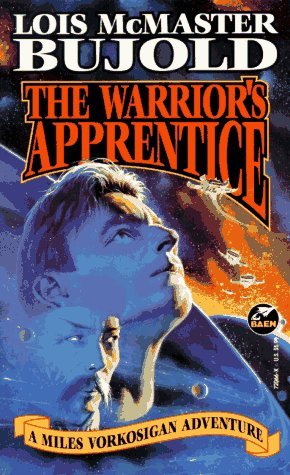
Miles Naismith Vorkosigan is the main character of most of the books in the series (the first two follow his parents). The series is set in a far-future, space opera universe.
(None of the following could strictly be considered spoilers, due to the flexible chronology mentioned above--you'd have to start at the very very beginning to not know any of it. But if you do want to start at the very very beginning, you might want to avert your eyes now and come back at the next bold spot.)
Miles comes from the planet Barrayar, which is very culturally averse to any sort of genetic mutation. Due to an attack on his parents when his mother was pregnant, his height is permanently stunted, which tends to attract a great deal of attention/disdain. Does this stop Miles? Let's see. In the first book in which he appears, he gains control of a mercenary fleet by accident, convinces everyone he's an admiral, wins a war, solves a plot against his father, gets his mercenary fleet included on the Imperial Security payroll, and is admitted to the Barrayaran Imperial Academy. Oh, and he's seventeen years old.
(As you were.)
I've always had a fondness for rogue heroes, and while Miles isn't a rogue per say, he does have that roguishly flexible attitude toward rules and regulations. (In an emergency, there's always the refuge of the Barrayaran Fire Drill. And I do mean always.)
Of course, one character can't carry a story all on his own. We have Miles's mother and father--parental badasses if there ever were some--prim Aunt Alys, a latter-day Catherine de Bourgh with a heart; his cousin Ivan, who has the most fantastic case of Obfuscating Stupidity that I've ever seen; deceptively quiet Emperor Gregor; Mark; Ekaterin---no, I won't spoil those particular plots, but that's where I came in on the story, so. Suffice it to say that I love them all, especially the female characters for making my feminist heart happy.

While I love them all--so far; I haven't read Cryoburn yet--A Civil Campaign has to be my favorite. It's a straightforward romance, if most romances involved political intrigue, insects, fugitives, garden trauma....
Here's how the description begins on the back: "It's spring in Vorbarr Sultana, and a young person's fancy lightly turns to thoughts of love...money....bio-genetics...love...lack of money...incompatible planetary sexual mores...love...District succession scandals...the Emperor's wedding...and, of course, love..." It's like Jane Austen decided to try her hand at political science fiction and found out that she was great at it.
A Civil Campaign also has one of my favorite exchanges in absolutely anything:
"Is that how you see marriage? As the end and abolition of yourself?"
"It is for some people. Why else do all the stories end when the Count's daughter gets married? Hasn't that ever struck you as a bit sinister? I mean, have you ever read a folk tale where the Princess's mother gets to do anything but die young? I've never been able to figure out if that's supposed to be a warning, or an instruction."
"You grow in different ways, afterward. Not like a fairy tale. Happily ever after doesn't cover it."
THIS. YES.
Happily ever after doesn't cover it in the Vorkosigan books, either, which is probably why I love them so much. Each plotline draws to an conclusion at the end of its book, but there's always space for something new. (Aha. Space. Accidental pun. Ba-dum-tish.)
So if you like sci-fi, interesting character studies, snappy comebacks, plasma rifles, genetic engineering, or mercenaries....read them. In whatever order you damn well please, the way the universe's God intended.

No comments:
Post a Comment